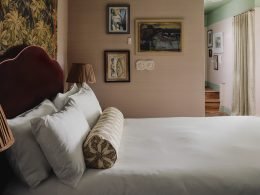








There is something deeply poetic about translating a feeling into physical form. Sydney-based interior designer Anna-Carin McNamara’s working world is an exercise in this universal form of language, shaping homes that hum with an almost-lyrical quality. Each space bounces between notes, speaking not to the latest finishings or commercial trends, but rather to the people and the lives that fill them. And it’s not by accident.
”We are the conduit between ideas and reality,” she tells me of her namesake studio. ”Most people have a feeling about the home they want to live in but no way of getting there. We translate that feeling into something real, specific and lasting.”
Raised on a farm in southern Sweden and educated at the Royal College of Art in London, Anna-Carin is a rarity in the interiors world—a creative who understands how to traverse the delicate tightrope of form and function without falling into stereotype. There is a restraint to her work that feels inherently Scandinavian, but also a depth that pushes beyond the often clinical perception of minimalist design. Her spaces are layered and tactile, deeply human environments designed not simply to impress, but to be lived in.

That philosophy has become increasingly central to her practice over time. Originally founded in 1996 as INNE in Sydney, Anna-Carin’s studio has evolved to better reflect her own understanding of what the home really means. Nowadays, it’s less a fixture of aesthetics and more an exploration of the emotional architecture of home.
”I have deepened my understanding of what a home actually is. Early in my career I thought it was largely about how it looked. I have come to understand it is so much more than that,” Anna-Carin says. ”A home is the fundament of how we feel about ourselves and the springboard to how we show up in life. When that is right, everything else follows. When it is wrong, you feel it every single day without always knowing why.”
Scandi design might well be in her blood, but there is a profoundly Australian sensibility to her work that cannot be denied. In her latest space, dubbed ‘Seven Days’, the designer pulls from all corners, constructing a space that emboldens mid-century Australian architecture with a healthy dose of post-modern influence.


Nestled in the lower ground of a 1940s sandstone post-war home in New South Wales’ Northbridge, the private retreat offers an offbeat, rustic and effortless take on secluded luxury. The space plays with texture and contrast, blending local sandstone with opaque glass bricks and timber panelling, the result of which is an almost achromatic design that feels uncharacteristically warm. It’s a uniquely iconoclastic approach, but in ‘Seven Days’, those varying influences are all singing from the same hymn sheet—quite literally.
The secret to bringing the project to life, Anna-Carin reveals, was a song.
”Before I draw a single line I ask every client for three things: a project name, three words describing how they want to feel in their home, and a song,” she tells me. ”The name creates ownership. The three words give us an emotional brief that sits above all the practical decisions. And the song does something no words can fully do. It holds a feeling. When you are six months into a project and facing a hundred small decisions, you go back to the song. It tells you whether you are still on track.”
For ‘Seven Days’, that song was Sting’s Seven Days; an irregular, slightly restless piece written in the unusual time signature of 5/4. As Anna-Carin explains: ”The song is very considered and a little melancholic. Offbeat, rustic, effortless were the three words. The name and song felt so strong so we chose the same. Together they made every decision easier.”
A striking residential project, ‘Seven Days’ feels like the clearest distillation yet of Anna-Carin’s philosophy. Beneath the textured surfaces and carefully balanced material palette hums a steady rhythm that explores why we connect with a space. Following the completion of the ‘Seven Days’ project, I caught up with Anna-Carin to chat about her influences, the project challenges and why the home is so much more than just a beautiful space.

Tell me a little about ‘Seven Days’. What was that project like?
The homeowners initially set out to manage the redesign independently, and inevitably had become lost. Too many choices, no thread to pull them together. I connected with the clients immediately. We found ourselves talking about music and rhythm almost straight away, which is always a telling starting point – this forms a key part of my process with every client. And then I saw the sandstone in the basement. Original, gorgeously unfinished, completely beautiful. It had been there the whole time, waiting. From that moment, the direction became clear. Our job was to find that thread and hand it back to them.
You mention that before you started, some key elements had already been chosen, but the project lacked a cohesive direction. How do you go about identifying that direction?
I laid everything out on the office floor. A piece of the sandstone. The terrazzo floor tile they had chosen. The solid timber beam sample. Photos of the heirloom pieces they had in storage. And a photo of a dog with a wagging tail, as that was the end goal for them, to have a dog when the project was finished. From there I added another tile, a colour swatch, a marble sample all while listening to ‘Seven Days’ and slowly the hole started to fill and the story could be told. The sandstone and the dog were saying the same thing; unpolished and alive.
Tell me a little about the history of the house. How did that play into the design?
The clients had lived in the home for many years and it carried their history. There had been serious water damage to the lower ground floor that had rendered part of the house uninhabitable, so there was also a story of damage and repair, of a home that had been through something and needed to heal.
We extended the lower ground out onto the oversized terrace to create a new living space, which we called the Sunday Room: The first of Seven Days. Large glass sliding doors on two sides flood it with light. The timber beams were continued across the ceiling, walls, doors and joinery to tie the heaviness of the existing structure into the new space. The house had good bones our job was to add the flesh. We installed a lift.. for those days.


Can you describe what the ‘3 Words and a Song’ method is and how to use it?
Before I draw a single line I ask every client for three things: a project name, three words describing
how they want to feel in their home, and a song. The name creates ownership. The three words give us an emotional brief that sits above all the practical decisions. And the song does something no words can fully do. It holds a feeling. When you are six months into a project and facing a hundred small decisions, you go back to the song. It tells you whether you are still on track.
For ‘Seven Days’, the song was Sting’s Seven Days; the song is in 5/4, an irregular, slightly restless rhythm. The song is very considered and a little melancholic. Offbeat, rustic, effortless were the three words. The name and song felt so strong so we chose the same. Together they made every decision easier.
Why do you think music, in particular, is such a powerful tool for defining space?
Because music bypasses the rational mind and goes straight to feeling. You can describe a room in a hundred words and still not capture what it should feel like to be in it. But a song gets there in three minutes. Design and music are also structurally similar. Both are about rhythm, proportion, tension and resolution. A room that works has the same quality as a piece of music that works. You feel it before you understand it.
Your work has a strong tactile quality, using materials that invite touch rather than just attention. Do you think people are craving a return to more grounded, sensory environments?
Yes, absolutely. We spend so much time looking at screens and imagery and it leaves us hungry for the real thing. Stone that is cool under our hand. Timber that has grain and a scent. Plaster that holds the light differently at different times of day. These things cannot be scrolled past and they require a different type of attention. You have to be in the room. I think we are beginning to understand the difference between a home that looks good on a screen or on paper and a home that feels good. Those are not always the same thing. We have always designed for the second one.
Anna-Carin McNamara is a Swedish-born, Sydney-based designer and the founder and director of interior design studio ANNA.CARIN DESIGN. With a career that spans more than three decades in the industry, the interiors expert has played a hand in some of the country’s most recognisable homes, including the recent 1940s sandstone post-war home, ‘Seven Days’.


More Art & Design Stories
Interested in reading more art and design news, reviews and guides? MADE Journal has you covered. In addition to our architecture and design features, we publish regular content focused on new exhibitions, restoration projects and community developments that work alongside local communities. Check out some of our other art and design coverage:
- ’The Only True Protest is Beauty’: Fondazione Dries Van Noten’s Striking Debut Revealed
- The Artist Behind Vogue’s Most Iconic Illustrations is Finally Back in Focus
- Never-Before-Seen David Lynch Artworks to Reveal the Artist Beyond Film
- Paramart is Sydney’s New Late Night Vending Machine Obsession
- ‘Collecting Ourselves’: The Search for Frank Lloyd Wright’s Lost Objects
- The Underground Art Scene at the End of the World
- Step Inside Thebe Magugu’s Afro-Modernist Sanctuary
- Fashion Designer Dries Van Noten is Defending Craftsmanship
- How Rachael Gowdridge Turned a Public Toilet into the UK’s Hottest New Hotel